Wednesday, October 15, 2008


Tuesday, October 14, 2008
And the winner is...
The winning team in the R+KU dialogue challenge is...drum roll.......


Team A with a 7.3 times increase in visits!
Congratulations to Ashley Seaton, Donna Giancarlo, Kelly Smith, Rosie Ralston, Kathy Sedlacek
Results:
(click to enlarge: visits by blog article)
Click to enlarge (visits resulting from Google AdWord ads)
For a complete look at the work check out:
Team A: Ashley Seaton, Donna Giancarlo, Kelly Smith, Rosie Ralston, Kathy Sedlacek
- Post #1: Reinventing traditional media.... Good, bad or ugly?:
- Post #2: How brands define our lives
- Post #3: Just Facebook Me.
Team B: Bridget Quinn, Emily Schachter, Shanetta MacDonald, Tina Baker, Rick Davis
The following ads for each area appeared on Google and the Google content networks:
(click to enlarge)

Team C: R+K Blog (Kristen Ewing, Laura Fitzgerald, Yvette Owen, Debra Graf, Kim Bergmooser)
Team D: R+K Blog (Christina Harp, Claudia Zellman, Robyn Keyster, Valerie Holland, Cindy Sanders)
- Post #1: Eek!..onomics
- Post #2: Look out! …for moving targets!
- Post #3: Questions, Questions!…
Thanks to everyone for the excellent effort.
The experiment: R+KU
Last week we used the blog as a tool for our R+K University* attendees.
The challenge was fairly simple: each of four teams was to generate content for this blog or create a Google AdWord campaign. The team that generated the biggest bump in site activity (i.e., visits) over the established baseline wins. No rules, no guidance, just good old figure it out yourself learning.
We'll announce the winners in today's session on Measurement...and post the results here in realtime.
The purposes of the exercise included:
- Awareness of the blog and search tools
- Experience in colloboratively developing online campaigns
- Preparation for measurement against objectives
Stay tuned!
*R+KU is our agency's internal training program for new employees. Over the course of 10 weeks, 20 or so new employees get exposed to the various philosophies, processes and people that make the agency what it is.
Monday, October 13, 2008
Research Methods: Confabulating Useful, Usable and Desirable
Confabulation is a term that describes the space between one's imagined truth and the actual facts. In describing behavior or attitudes, people abhor a vacuum. So when we don't remember what we did--or why--we'll create a narrative to fill the void. Mostly, we do this unconsciously or with very little recognition of what we are doing. That's confabulation.
Put another way, confabulation is the difference between our peronsal truths and the actual facts.
Confabulation presents a particular challenge to marketing researchers in that research subject's explanations of behavior may not be what they seem. Attitudinal research is no better able to address the issue given it's general requirement to ask the person with the attitude just what 'it' is and where they got 'it'...and of course, researchers being human, they may create their own confabulations for defining and explaining attitudes in others.
Without digressing into a philosphical discussion of the limits of our perceptual abilities, Jakob Neilsen has posted a matrix of research methods and when to use them. Though crafted in the context of usability research, they are applicable in any marketing context from product design, to customer service, to the ever mysterious practice of 'branding'.
In the end, these methods provide a breadth of support for the discovery and creation of experiences that are useful, usable and desirable...even with the attendant uncertainty of confabulated results.
(click to enlarge)

Friday, October 03, 2008
Guest blogging: Wisdom of the crowd
Next week (10/6) the postings here will be done by a group of guest bloggers.
As part of our agency's professional development program, we run "R+K University" for new members of our agency team. Next week, we'll have groups from the latest session of R+KU taking over the reins of this blog.
The topics should be insightful, diverse and well worth the read...unlike what's normally here :-)
I hope you'll plan on checking them out. It all starts next Tuesday.
Thursday, October 02, 2008
State of the blog: Useful, usable, desirable
We advocate a view of design online that incorporates three elements: useful, usable, desirable. If a design is deemed by an individual to be these things, then it is good. If not, it's not. So though this lens, let's look at blogs, bloggin and the blogosphere.
Actually, let's look at what Technorati says first. Technorati has released it's fourth annual report on the state of blogging and the interconnected community referred to as the 'blogosphere'.
You can read the whole thing here.
A few thoughts:
Advertising: Only 53% of blogs globally sell advertising space. Given that advertising is the predominant means of monetizing content on blogs, we are confronted with the reality of most blogs: they are created primarily with non-financial motivators in mind. Among those blogs that do offer advertising, the median revenue is less than $100/year.
Trendiness: While it's easy to start a blog, anyone whose doe it will tell you that the heavy lifting comes in continuing to publish. Estimates by McCann, Technorati and other place the number of US bloggers between 22 and 26 million. Technorati reports that 1.5 million of these have had postings in the last 7 days (see graphic below). In addition these blogs have more than 66 million readers according to eMarketer and comscore.
Demographics: While US blogger would seem to be more evenly divided by gender, the average tenure of a blogger in the US is 35 months. These folks mostly (74%) also have college degree; a slim majority make more than $75,000 annually; and, a majority are over the age of 35.
So what?
Blogs, blogging, and the blogosphere are just terms to describe personal web publishing. Much has been made of high profile, journalistic approaches to the use of these tools. In the end, though, blogs are created and maintained because they support individuals in their need for useful, usable, and desirable content publishing tools.
When blogs are read, its for the same reasons.
(Click to enlarge)

Wednesday, October 01, 2008
The wayback machines: the internet's rear view mirror
Many think of the innertubes as a domain of ever-changing, what's-next content.
But yesterday is today with two backward-looking applications:
The internet wayback machine is an archive of web pages that goes back (for some sites) as far as 1996. It's a fascinating anthropological look in the rear view mirror at the state of the web just a decade ago. For some sites, it surely shows how far things have come (Amazon.com: 2000 and 2008).
Though the display isn't always complete (broken links and missing images being the biggest holes), it can be a fascinating look at what was important--or at least prominent--on various sites.
It can be a bit like revisiting those high school year book photos...embarrassing, and, if you are prone to it, nostalgic.
Another tool, available (for one month only!), is Google's index 2001. In celebration of their 10th anniversary, Google released the search index as it existed in 2001. Try a few searches on terms that, today, seem like decades ago.
Tuesday, September 30, 2008
Stupid networks: Delivering the goods
As with most aspects of the future, someone somewhere probably thought about it long before it became obvious to the rest of us. Take the network.
Way back in 1997, a network engineer for AT+T (the prior version, before it disappeared and then was reincarnated by SBC) named David Isenberg wrote a paper called "Rise of the Stupid Network". You can view it online here.
The premise of the paper was to challenge the status quo thinking of the telecoms...no mean feat for someone employed by a company that had created one of the world's most powerful telecom companies based on certain assumptions about their value proposition.
Isenberg identified these assumptions that in turn held the companies hostage to thinking differently about their role in a changing world. These assumptions included:
Now take Isenberg's view and apply it to any network...television, radio, online advertising.
The parallells are readily observable: if intelligent devices are located at the end of the network (computer screens for watching TV programs; gaming; and connecting the weekend call to your mom) then the network's sole value is to carry content.
And if your sole job is to carry content, then you want all the content the people connected to your network can get. If you create content, you want it to be available on any network you can get it on that will support your goals...want to talk to your sister through a mobile device or your computer? Which network is deisgned to support your needs.
Want to watch reruns of The Office while your in the office? Which network supports your device?
In the ever emerging future of the stupid network, walled gardens and network content exclusives will certainly exist. But the transition will make those practices harder to support financially. The flexibility demanded at the ends of the network will exceed the capacity of any one network to meet the diverse needs of users by doing anything but delivering the data.
For broadcasters, certain realtime events like sports or news might capture large audiences. Ultimately, though, the traditional networks will have to make a decision between being a provider of conduit or content. One or the other is where the smart money will be.
Trying to be everything to everyone is a recipe for extinction.
Way back in 1997, a network engineer for AT+T (the prior version, before it disappeared and then was reincarnated by SBC) named David Isenberg wrote a paper called "Rise of the Stupid Network". You can view it online here.
The premise of the paper was to challenge the status quo thinking of the telecoms...no mean feat for someone employed by a company that had created one of the world's most powerful telecom companies based on certain assumptions about their value proposition.
Isenberg identified these assumptions that in turn held the companies hostage to thinking differently about their role in a changing world. These assumptions included:
- expensive, scarce infrastructure can be shared to offer premium priced services,
- that talk - the human voice - generates most of the traffic,
- that circuit-switched calls are the "communications technologies" that matter, and
- that the telephone company is in control of its network.
Now take Isenberg's view and apply it to any network...television, radio, online advertising.
The parallells are readily observable: if intelligent devices are located at the end of the network (computer screens for watching TV programs; gaming; and connecting the weekend call to your mom) then the network's sole value is to carry content.
And if your sole job is to carry content, then you want all the content the people connected to your network can get. If you create content, you want it to be available on any network you can get it on that will support your goals...want to talk to your sister through a mobile device or your computer? Which network is deisgned to support your needs.
Want to watch reruns of The Office while your in the office? Which network supports your device?
In the ever emerging future of the stupid network, walled gardens and network content exclusives will certainly exist. But the transition will make those practices harder to support financially. The flexibility demanded at the ends of the network will exceed the capacity of any one network to meet the diverse needs of users by doing anything but delivering the data.
For broadcasters, certain realtime events like sports or news might capture large audiences. Ultimately, though, the traditional networks will have to make a decision between being a provider of conduit or content. One or the other is where the smart money will be.
Trying to be everything to everyone is a recipe for extinction.
Monday, September 29, 2008
Fishing for an audience: Podcasting
Like Kleenex and tissues or Xerox and copies, podcasting has been genericized to define any audio content that can be downloaded for later use--excluding music. Born of the rapid expansion of iPod ownership, podcasting has gathered all manner of supporters in corporate marketing and agency departments.
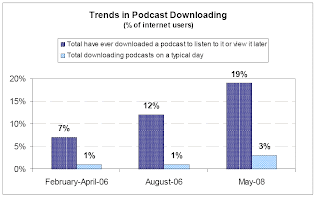
But the Pew Internet and American Life project's latest research into podcasting may call into question the viability of podcasting as a mechanism worthy of its attention level: according to Pew, only 19% of internet users have ever downloaded a podcast. An even smaller 3% of internet users download a podcast daily.
And while 20% is certainly nothing to sneeze at, it represents only 7% growth from the numbers reported 2 years ago. Meanwhile, the devices from which podcasting takes its name (i.e., iPods and similarly capable) are now in the hands of 43% of internet users.
So what?
With more than 43,000 podcasts containing more than 2 million episodes logged by the directory Podcast Alley, it would seem that podcasting--like so many other niche applications online--is a Long Tail application at best. And for those considering a podcast, building an audience will still be the first challenge.
We've recently produced and developed two significant podcast campaigns with very different approaches to audience aquisition: Both targetted to small audiences of influencers. In one, we used a promotional mailing to gain interest and garnered more than 40% response to the four-part podcast series. In another, we relied on a more traditional approach with a 3rd party web publisher. The results for this effort were less satisfactory (though well within the cost per user guidelines for the project).
A summary chart from the Pew Research report below (click to enlarge)
For a top of the week musical interlude, a Fisherman named John:
Thursday, September 25, 2008
Battle of the online ad planners: Quantcast vs. Google
While attending the Worldwide Partners Media Conference yesterday, talk turned to online research tools. And while there seemed to be general revulsion at the 'pay more for less' approach being taken by Neilsen and select others, two tools were mentioned that are (currently) free: Quantcast and Google AdPlanner (you must have a Google account).


Though these tools are touted primarily as ad planning tools, the data that they provide about sites makes them viable research tools.
We've used AdPlanner and have previously posted on it, here. A quick trial of Quantcast indicates many of the same features as AdPlanner, including:
- It's free
- Demographics of a site's user base
- Estimated traffic
- Other sites likely visited
- Search terms used to locate the site
Quantcast uses a combination of cookies and panel data to assess each site's demographics and descriptors. At least that's what they say. Google doesn't say, though I suspect panel data isn't included.
Like AdPlanner, some sites are too small to have data in Quantcast. Unlike AdPlanner, small sites may still have profiles with a small warning that the data is primarily extrapolated from panel data. And that can bring up some interesting profile elements.
One of our client's sites is described with what appear to be accurate demographic and age breaks (or at least consistent with in-market research they have conducted). What's fascinating is that of all the other affinities this demo might have listed, Quantcast indicates that they may be likely to stay in Super8 Motels or The Hilton...hmmm.
AdPlanner does show a few more elements associated with competitive or related sites and the keywords used by the audience to find them, but overall, the two applications are very similar in the utility for research purposes. Quantcast provides race data in its demographics, which Google does not though one might ask how accurate--or important--that is or should be.
Besides the declared transparency of the source data, the biggest difference between the two applications (in their use as research tools) is the screen layout. Quantcast data is displayed in easy-to-grasp graphics presentations. Both applications take a dashboard-based approach to overall layout.
Here's two grabs researching the same site from AdPlanner and Quantcast.
(Click to enlarge)
Both tools deal in data that homogenizes us into our grosser commonalities. In so far as this is still the approach taken to media planning, both tools would seem to be up to the task of identifying where the collective 'we' go...what we as individuals actually think, beleive, or do is--for now--not included.
Wednesday, September 24, 2008
Regarding analytics
Karne Breen Vogel of Chicago's ClearGauge spoke this morning on measurement and analytics. A few things that stuck out:
- The data isn't what is important in evaluating success but the trends it indicates are.
- The generic measure of success online is: Was the visit successful for the visitor?
Regarding Analytics:
The evolution of online measurment and analytics is proceeding from simple traffic to path analysis to key performance indicators...financial valuation (putting a monetary value on the visitor) and predictive analytics (looking at behavioral and attitudinal data to predict customer behavior) are less developed at this time.
Part of the message of this presentation is to do something that makes sense...determine what's important to measure and define metrics for it: what a download is worth...here's what a page view is worth....in many ways this is at the heart of the return on marketing investment modelling that we often use.
Four Steps to implementing analytics for clients:
1. Establish ownership: whoever owns the business goals should own the metrics and analytics
2. Tie to goals of the business
3. Define visitor success miletone points...what is point where you can measure visitor success on the site
4. Create key performance indicators
Examples of KPIs include:
- Lead qualification: Ratio of lead to unqualified; unique visitors to qualifid leads; cost per qualified lead; qualified lead to sale; timet o close;
- Lead generation
- Increase revenue
- Prospect engagement/education
- Awareness: return visitors to visitors
- Reduce costs
- Prospect need fulfillment
- Ritual/behavior change
Examples of tools for collecting data on KPIs can be broken into two types, based on the data type:
For attitudinal data:
- usability testing
- online focus group
- intercept surveys
For behavioral data:
- multivariate testing
- webanalytics
Tuesday, September 23, 2008
Buying in: Why we desire brands
Buying in: The secret dialogue between what we buy and who we are is the latest offering (in book form) from NYTimes consumer columnist Rob Walker.
In his talk, Walker sought to give his view of why we (as consumers) desire some brands over others. And while no definitive answer emerged from his talk or the questions that followed, he did articulate rational and emotional elements that he beleives influence people's attachment of an idea to a thing (aka branding):
The 4 (and a half) rational qualities that impact consumers decisions include:
- Price
- Qualtiy
- Convenience
- Pleasure...
- and maybe ethics (provided it doesn;t require a sacrifice in the first four).
Where it gets messy is, of course, the emotional side of the equation. Walker beleives from his interviews and research that the ideas being attached to brands today are so much bigger than ever before. Not merely content to have 'the highest quality soap' as an idea, we attach ideas about body image or global sustainability.
The marketing world of attaching ever bigger ideas to everyday consumption has created an arms race of ever increasing clutter of ideas. Which leads to another change: a lack of rules is what makes a brand succeed in this environment. Rules about media mix, demographics and the like have to be thrown out or at least deviated from for success.
At the end of the brand, people make it their own, regardless of what the marketers would like it to mean (e.g., Pabst Blue Ribbon)
To support this notion, the speaker cited several examples of the handmade/authenticity movement or, as he repeatedly referred to it, the 'scene'.
In this scene, big companies cozy up to small ones to get credibility...think Kohl's and Tony Hawk or methamphibians and counterculture-friendly sneakers. Other examples include the handmade marketplace online at ETSY.com
The web didnt make these people creative, they were already that way ;-) It's just enabled them to reach a small, economically viable audience for their work. Freedom of the press no longer being limited to those with the ability to afford one.
Rob submits that consumers don;t want to talk about your brand, they want to talk about their own brands. A term he calls 'murketing'. More on this is available at a site he publishes called Murketing.com
Monday, September 22, 2008
Research goes responsible
The conversation is changing...rapidly. From obsession with tech to depression over oil...the consumer is talking in terms of social responsibility, global 'issues' moreso than 'opportunities'..and of course the economy.
Someone once said that the stock market didn't cause the Great Depression, the societal depression caused the stock market crash. Research firm Yankelovich is picking up on the riff that economic anxiety is rapidly moving up for that homgenous tribe known as 'The Consumer".
Their latest research report, to be released tomorrow, indicates that high anxiety is on the rise. In fact the trend is so pronounced, that Yankelovich is updating all their research through the lens of consumer anxiety. Some fndings about consumer expectations:
- Cheaper does not equate to lesser...
- Expectation for customer service is increasing, arguably out of a sense that the provider of service 'should be grateful for my business'.
- Unwilling to lower expectations sets us up for a crossroads.
IF people have learned to assume they are in control, what happens when the economy makes it harder to service that expectation? This is the new responsibility marketplace.
In this marketplace, which is in the process of emerging, the consumer empowerment movement of hte last decade+ becomes a means rather than an end goal. What is the goal? This is individual. It's about:
- Making touch choices.
- Pragmatism and practicality
- Ownership of our challenges.
What is the reaction of the 'iConsumer' to th e realities of economic limits? The research does not see victimization among consumers, despite some of the headlines.
AN interesting finding is that, for those who have severe economic anxiety, the need for 'new' increases...can we assume that thrill seeking behavior will be sought out? Perhpas alcohol and tobacco? It seems we've been here before, but thats a tough call to extrapolate to each of us as 'the consumer'.
Overall, there is also a need for 'real' and 'pure'. People are saying its hard to find trustworthy information (61% asked). We all think we are better than everyone else at things, including idenitfying what's 'truth'.
Listening to Yankelovich's report, it sounds indeed like the country is depressed. We'll know soon enough whether the chicken or the egg calls the shots. Either way societal acrimony looks to be part of the journey ahead.
WPI Media Conference Posts: 09/22/08
The Worldwide Partners network of independent global agencies is holding its annual media conference in Chicago today and tomorrow. I'll post notes and thoughts from the conference, which includes discussions and presentations from consumer research company Yankelovich, Forbes Publisher Rich Karlgard (see his blog here), and many others.
Friday, September 19, 2008
(Financial) Times like these
"This troubled asset relief program must be properly designed and sufficiently large to have maximum impact..."
So says Treasury Secretary Hank Paulson. About $150 Billion should do. Where will that money come from?
Why from the cause of the problem...me and you.
Mac Thinks Different about...intrusion
As a counterpoint to the new Microsoft ads, Apple has released online banners that perpetuate the hip, Mac style at the expense of the pudgy, unhip PC...using intrusion...see for yourself in this screen cap video from Techcrunch:
Just teasing: Bill + Jerry as warmup acts
Like warming up the crowd before the headliner takes the stage, Microsoft says today that the first two ads in its $300 million campaign were just...um, warm ups. As previously posted here and here, we--like many--weren't sure if it was slow-reveal brilliance or a quick spew of head scratching incompetence.
Either way, the idea promoted by Microsoft's Brand Manager that the new campaign illustrates a strong desire among Microsoft managers to...“have a conversation about the real PC.” is kind of laughable in the context of a talk-at-me advert.
Several professional opinions are offered at the NYtimes and AP (not that getting paid makes an opinion any more right)
Paying Sienfeld $10 mil for two spots sure seems like an expensive way to do a warm up act for the soon to bne aired 'real' spots. Then again, with the way the Federal Reserve, er, I mean Microsoft is printing money, a $300 million ad campaign may not be that big of a deal.
Either way, the idea promoted by Microsoft's Brand Manager that the new campaign illustrates a strong desire among Microsoft managers to...“have a conversation about the real PC.” is kind of laughable in the context of a talk-at-me advert.
Several professional opinions are offered at the NYtimes and AP (not that getting paid makes an opinion any more right)
Paying Sienfeld $10 mil for two spots sure seems like an expensive way to do a warm up act for the soon to bne aired 'real' spots. Then again, with the way the Federal Reserve, er, I mean Microsoft is printing money, a $300 million ad campaign may not be that big of a deal.
See the new Pride ad here:
It kind of makes those Apple ads seem not so funny anymore.
Thursday, September 18, 2008
Tracking people: the innocent have nothing to fear
In the Tom Cruise sci-fi film Minority Report, I was always tickled by the scene where his character enters a Gap and is greeted by an automatic voice that recognizes him as he enters the store and attempts to convince him they have new styles in stock he might like. It was funny because of the total irrelevance of the messaging to the character's context for being in the store (if you haven;t seen the movie I will just say that he had weightier matters on his mind). The technology to make such a marketing experience possible, though, wasn't far fetched at all.
In fact, Radio Frequency Identification (RFID) has been employed as a way to track cows, commodities, and other inanimate objects for years. But tracking people, in public, well somehow that seemed scary and inevitable at the same time. And so here we are.
Alliance Tech is a company specializing in the application of affordable RFID-based ID systems for use in tradeshows. Tradeshow marketers can set up a series of scanners around the tradeshow floor that will read the presence of a tiny wireless chip embedded in attendee passes or badges. And unlike other forms of badge swiping, the wearer (or shall we say, conference cattle?) don't have to take any action for their movements to be registered.
Alliance says its systems don't store personal data--in the same database--as that used at the conference and that the number of people opting out is less than 2%. I'll have to trust them that the opt-out process is clear and straightforward. For conference marketers, the data can be used much like web traffic reports--you might know which prospect company's employees stopped by your booth but didn't talk to anyone (sort of like a bounce rate in web parlance). You might be able to see what other booths they visited (i.e., a click path)...you might even decide to greet certain prospects by name and make them an offer of information, material, or dinner.
The scanners rent for $1000 each for a typical two-day convention. The company has plans to rent to malls whose high-end customers (is mall and high-end an oxymoron?) might be willing to sell their privacy for a few dollars off...as long as it's their choice.
In the transparent society enabled by cheap-technology, we may have finally found Big Brother...surprisingly to some he looks alot like Us.
Wednesday, September 17, 2008
Whose foolin' whom? DVRs, product placement, and the death of intrusion
Yes, everyone with a DVR or TiVo it seems skips the ads. Advertisers and the networks that sell to them have been concerned for several years about the unfortunate habit viewers have of only wanting to see what matters to them...and ads, apparently, aren't it.


Alas, one approach has been to stick the product in viewers faces where they can't skip it...in the show! Noone will notice, er, I mean noone will be able to skip it there. And think of the added credibility of the brand when someone as awesome as Michael, um, I mean Steve Carrell uses our product in the context of the The Office! Or one of the true arbiters of American Idolatry sips a Coke after another rousing amateur is made into a star we all surely love.
Product placement isn't new. But like Fed Bailouts, 3rd string quaterbacks, or hair of the dog, they may very well represent desperate measures for desperate times. They are an attempt to support intrusion as a viable model for selling ads. As people skip the ads, avertisers rightly question whether they should pay for impressions that do not exist.
Product placement today suffers some of the same challenges to measurement as the traditional interruptive model of the 30-second spot or commerical pod. In the case of product placement,though, the additional challenge is in not seeming so obvious that it seems unnatural--and yet to seem natural requires that the product get pushed to the background. In any case, just like the unfounded fears of subliminal advertising and the Hidden Persuaders in the 1950s, trying to be too sneaky about product placement gets legislators and other consipracy theorists up in arms...as in the FCC's latest effort looking into product placement.
At least when radio broadcaster and master hawker Paul Harvey stated...
"I am fiercely loyal to those willing to put their money where my mouth is."
...you knew exactly what he was doing because he was telling you.
Neilsen reports the number of product placement events by braodcast and cable in the charts below. Now you know.
(Click to enlarge)
Tuesday, September 16, 2008
Designing for the user: Will it work?
Good product design incorporates (among other things) three fundamental elements: Utility, Desirability, and Usability. These three elements don't lend themselves to neatly symmetrical graphical representations, though, because usability is by far the most critical of the three.
Think of it this way: no matter how useful an idealized product would seem to be, no matter how desirable the idealized outcome of using the product is to you...if you can't make it work for you, then the product experience risks failure due to usability issues.
Usability issues are why help desks and user guides exist. An entire series of 'For Dummies' books has been published to address what are, in essence, usability issues. Taken to an extreme, one could even argue that the entire education system is an attempt to make the world more usable for each generation that will inherit it and to share usability improvements made in prior generations. Or maybe that's too far.
So let's step back, way back, to design of interactive media. Information products, like web sites and applications, certainly need to be useful, desirable and usable. And if usability is the key to unlocking the doors of utility and desirablility online, how does one evaluate the usability of design online?
We certainly prefer to conduct detailed task analysis, interaction design, hi- and lo-fidelity prototyping and formal usability tests, but the reality of the world demands alternatives. One alternative we've used to great effect is to employ a Heuristic Evaluation Checklist.
The checklist provides a means of quickly evaluating a designs usability by inspecting it against a set of standard questions. It requires no particular expertise to employ, only a willingness to employ structured observation and critical thinking. It can be done formally--with data--or informally via discussion. Either way, it beats the alternative: failure.
Here's four elements on a checklist we use:
1. Is the design efficient?
- Is it faster than the old way?
- Does it support power users and novices?
- Does it support the way users perform their task?
- Are response times fast enough to keep up with user's work rate?
2. Is it intuitive?
- Does interaction take advantage of user's mental models?
- Does it behave consistently throughout the task?
- Is it visually consistent?
3. Is it supportive?
- Is it easy to undo mistakes?
- Does the design provide advice/reference materials/tools?
- Will users be able to perform their work better than they otherwsie would?
4. Is it engaging?
- Can users focus on their work instead of the interface?
- Do users have control...and beleive they have control?
- Is the experience enjoyable or even...fun?
What's in your checklist?
Subscribe to:
Posts (Atom)


